Project 02 / Public preview
ClaimGraph
A visual workspace for inspecting claims, counterclaims, evidence, provenance, and unresolved gaps.
- Year
- 2026
- Duration
- Public preview · 2026
- Role
- Product developer · Full-stack developer
- Discipline
- Research software · Graph interface
- Services
- Product design · Information architecture · Graph interaction · Full-stack development · Security and provenance
Context
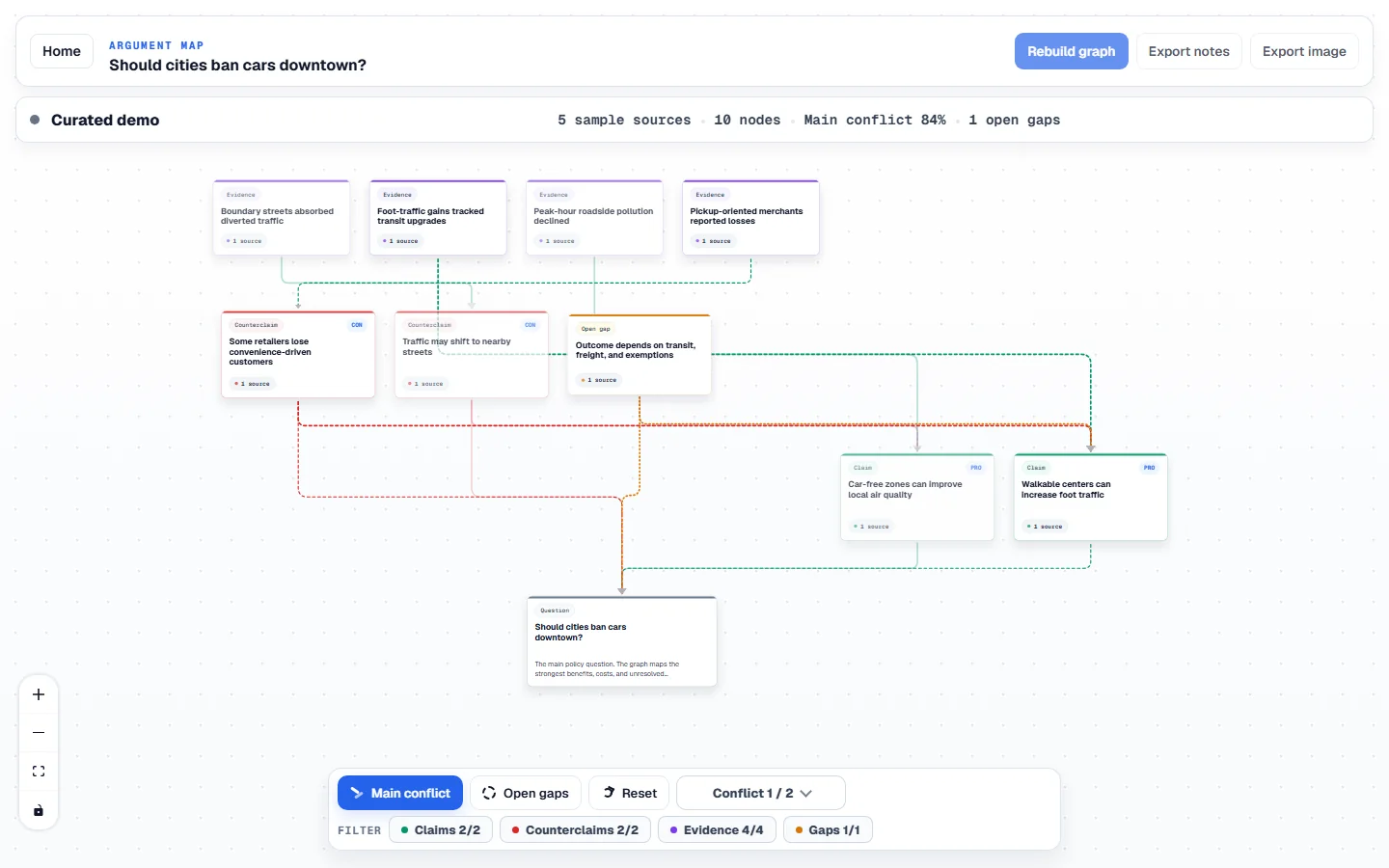
Long summaries can make a contested issue sound settled while separating conclusions from their sources. ClaimGraph turns a question and bounded source material into an interactive argument map. Claims, counterclaims, evidence, and unresolved gaps remain connected to provenance so a reader can inspect the structure of the reasoning instead of accepting a generated answer at face value.
Challenge
The graph needed to stay readable as evidence accumulated, support public links and document uploads, and expose uncertainty without claiming to determine truth. At the same time, sharing had to remain safe: public viewers could inspect a workspace, but only an owner capability could mutate it. Failure, cancellation, and retries also had to avoid publishing stale or mismatched results.
Decisions
Make the graph the product
The interface is organized around an inspectable map rather than a chat transcript. The strongest conflict can be focused without deleting the rest of the argument.
Bind every substantive node
Claims, counterclaims, evidence, and gaps retain source and snippet provenance. Confidence describes grounding and placement—not truth.
Keep layout and lifecycle deterministic
Application code controls node placement and guarded run states. Read-only snapshots are built through explicit public schemas instead of leaking internal storage objects.
System
- Bounded intake
- Public URLs and bounded PDF, DOCX, Markdown, and text uploads enter through constrained retrieval and extraction paths.
- Graph model
- Atomic node types, typed relationships, deterministic layout, conflict focus, and gap-aware filtering keep the visible map coherent.
- Ownership
- Public shares are read-only; mutations require an owner capability, and public payloads use allowlisted schemas.
- Delivery
- Next.js and TypeScript power the interface, with local and hosted storage adapters, Markdown/PNG export, and automated quality gates.
Outcome
ClaimGraph launched as a public preview with a curated demo, URL and document intake, a focused source inspector, deterministic graph layouts, read-only sharing, and Markdown or PNG export. The repository includes unit, integration, route, storage, lifecycle, security-boundary, and browser-facing regression tests. The hosted preview is intentionally labeled so users do not submit confidential or regulated material.
Process
The product was narrowed around a strict principle: if a reader cannot inspect the evidence and unresolved assumptions, the graph has failed. That led to explicit gap nodes, provenance on every substantive node, deterministic coordinates, guarded lifecycle transitions, and a curated fallback that remains explorable when a connected analysis service is unavailable.
Selected views
Credits & links
Product and full-stack development by Pram.